
Tar and Chip or Asphalt: Which Driveway Should You Build?
Tar and chip costs less per square foot, lasts close to 10 years, and sheds loose stone at first. Hot mix asphalt costs more up front, lasts 20 years or more with upkeep, and comes out smooth and black. A long rural drive usually favors tar and chip. A short suburban driveway usually favors asphalt.
Greenfield Pavement Coatings builds both. We lay chip seal driveways on long drives and farm lanes across Clarksville and the Nashville area. We pave hot mix asphalt driveways at homes in the same towns.
How is a tar and chip driveway built?
Tar and chip is the old name for a chip seal, and the tar is an asphalt emulsion today. A distributor truck sprays it hot, and a spreader covers it with clean stone chips right away. Rubber-tired rollers then press the stone into the binder. TDOT’s road specification allows no more than two minutes between the spray and the stone.
A new drive gets two coats, a larger stone first and a smaller stone on top. A state university’s dirt and gravel roads program calls a double coat the minimum for a gravel lane. A state highway department’s pavement guide says a double seal gives a harder, longer wearing surface. Under it all sits a shaped and compacted stone base with a crown. The same guide lists base failures and ruts as problems no chip seal can fix.
Weather matters too. TDOT’s spec allows a seal coat only between April 15 and October 1. The surface must be dry and the shade temperature 70 degrees or more.
How is a hot mix asphalt driveway built?
Hot mix asphalt arrives from the plant hot. A paver lays it and a steel drum roller compacts it. A state asphalt pavement association’s technical brief describes the standard home driveway. It calls for 6 to 8 inches of crushed stone base. On top go a 2 inch bottom course and a 1.5 inch surface course.
The ground under the base needs to be smooth and firm, with topsoil and roots cut out. The federal soil survey shows slow-draining clay subsoils across this area, so the drive needs a slope that sheds water. New asphalt driveways follow that recipe at any length. Fresh asphalt can take a car soon after rolling.
Both materials are warm-season work here. NOAA’s normals for Clarksville put the last spring freeze near April 5 and the first fall freeze near October 31.
What does each one look like?
A tar and chip drive looks like a country road. The surface shows the stone, so the color is the stone’s color, and the texture is rough and matte. That texture is grip, and road crews use chip seal for its skid resistance.
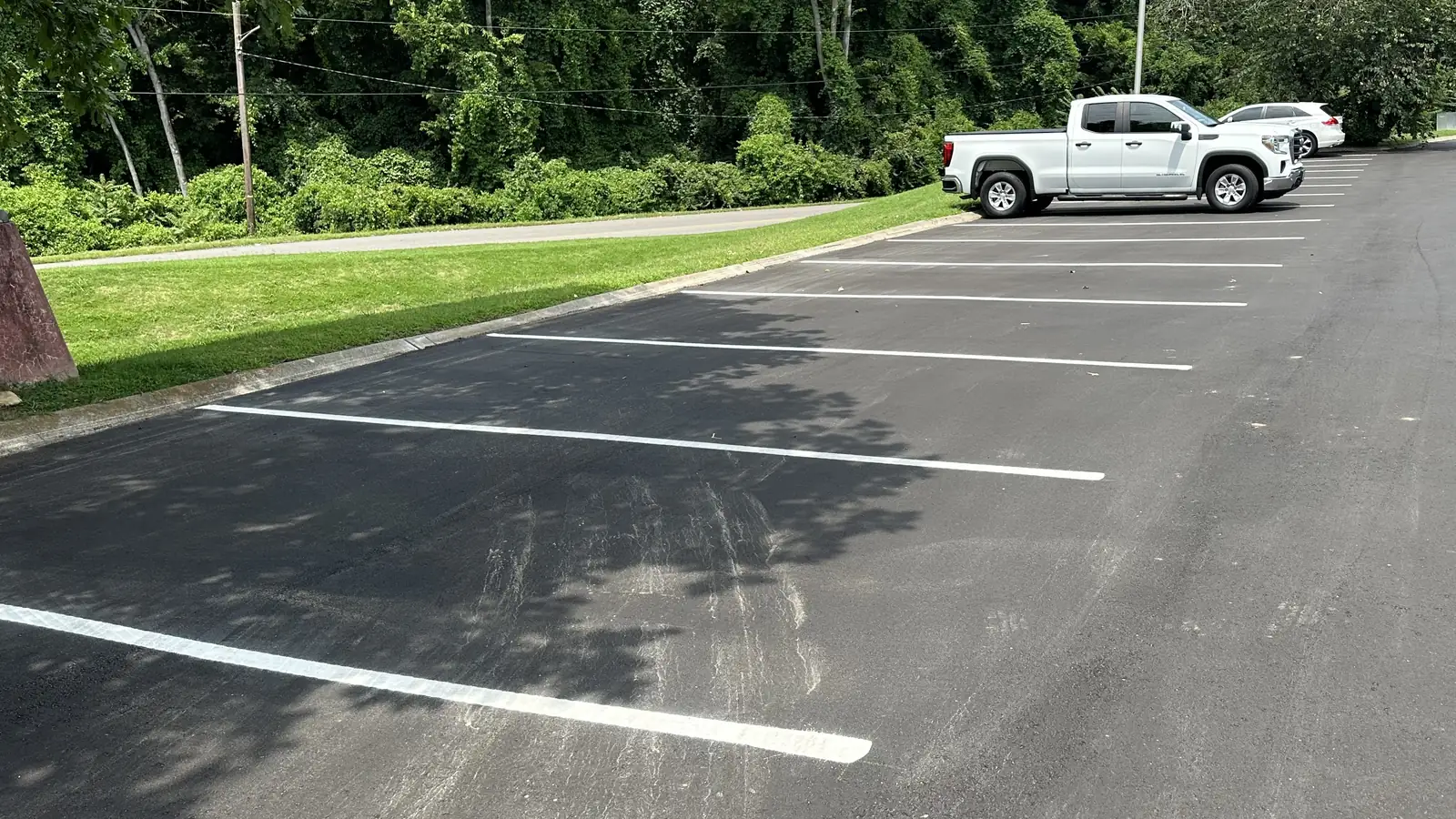
Hot mix asphalt comes out smooth and deep black with clean edges. Sun and air harden the binder, so the black fades to gray and the surface turns brittle. A sealer brings the black back and slows that aging.
What upkeep does each one need?
Tar and chip needs sweeping at first and a new coat later. A 2026 national cost guide says most tar and chip drives run close to 10 years. Then a fresh coat of emulsion and stone goes on top. A county road department notes that a chip seal re-seals its own small cracks in hot weather.
The asphalt industry’s engineering institute says a well-built driveway should not need sealing for its first 2 to 5 years. After that, a state asphalt association suggests a sealer every two to five years. National cost guides price a sealcoat at about $0.20 to $0.30 per square foot. Cracks get filled before they spread, and the edges stay backed with stone or soil. When an asphalt drive wears thin over a sound base, an asphalt overlay gives it a new surface. The association brief puts that overlay at 1.5 to 2 inches.
How long does each one last?
The asphalt industry’s engineering institute puts the average life of a chip seal at five to eight years. One county road department averages seven years on its roads and says traffic sets the number. A driveway sees far less traffic. The 2026 cost guide puts a tar and chip drive at close to 10 years.
National cost guides put a well-kept asphalt driveway at 20 to 25 years, and one says 25 to 30. Two state asphalt pavement associations say a well-designed driveway gives up to 20 years of service. The base decides most of that number. Clarksville sees about 78 freezing nights a year by NOAA’s normals, and most thaw by afternoon. That cycling opens cracks and works water into the base under either surface.
What do tar and chip and asphalt driveways cost?
These are market numbers from national cost guides updated in 2025 and 2026. They are not a price list.
| Tar and chip | Hot mix asphalt | |
|---|---|---|
| Cost per square foot, installed | $1 to $5, about $3 typical | $3 to $15, most jobs $6 to $9 |
| Published job totals | $360 to $2,900, about $1,600 average | about $3,600 to $5,400 for 600 square feet |
| Service life | close to 10 years on a drive | 20 to 25 years with upkeep |
| Upkeep | sweeping, then a new coat at about 10 years | sealer every 2 to 5 years, crack filling |
| Build window in TDOT’s road spec | April 15 to October 1, 70 degrees or more | thin lifts off the road November 30 to April 1 |
The per-foot gap is what matters on a long drive. A 12 foot wide drive that runs 300 feet is 3,600 square feet. At $3 a square foot that is about $10,800, and at $7 it is about $25,200. On a 20 by 20 foot pad of 400 square feet, the same gap is about $1,600. That is simple math on the published rates.
Size sets the base price for both. Beyond that, the cost guides point to the slope, site prep, stone type and what sits there now. On a chip seal the number of coats moves the price, and on asphalt the thickness does. For more on the asphalt side, read what a new asphalt driveway costs in Tennessee.
Which one fits a long rural drive, and which fits a suburban driveway?
Pick tar and chip for a long drive, a farm lane or a gravel road you want to tame. The cost gap grows with every foot, and the look suits open land. A state university’s gravel roads program points to chip seal for lanes with heavy farm loads and steep grades. If the lane is raw dirt, grading comes first, and that is a separate trade.
Pick hot mix asphalt for a suburban driveway. The drive is short, so the dollar gap is small, and the smooth surface earns its keep every day. Cars turn and back over the same few hundred square feet, and that traffic whips chips loose. A national cost guide says tar and chip performs best in rural settings with low traffic.
Which one is right for your drive?
Greenfield Pavement builds tar and chip for long drives and hot mix asphalt driveways across Clarksville and the Nashville area. Call or text (931) 362-7283 with the length of the drive and what sits under it now. We look at the job and put the quote in writing. Ask any quote to spell out the base depth and the coats or the thickness.