
Crack Filling vs Crack Sealing: Which Does Your Driveway or Parking Lot Need?
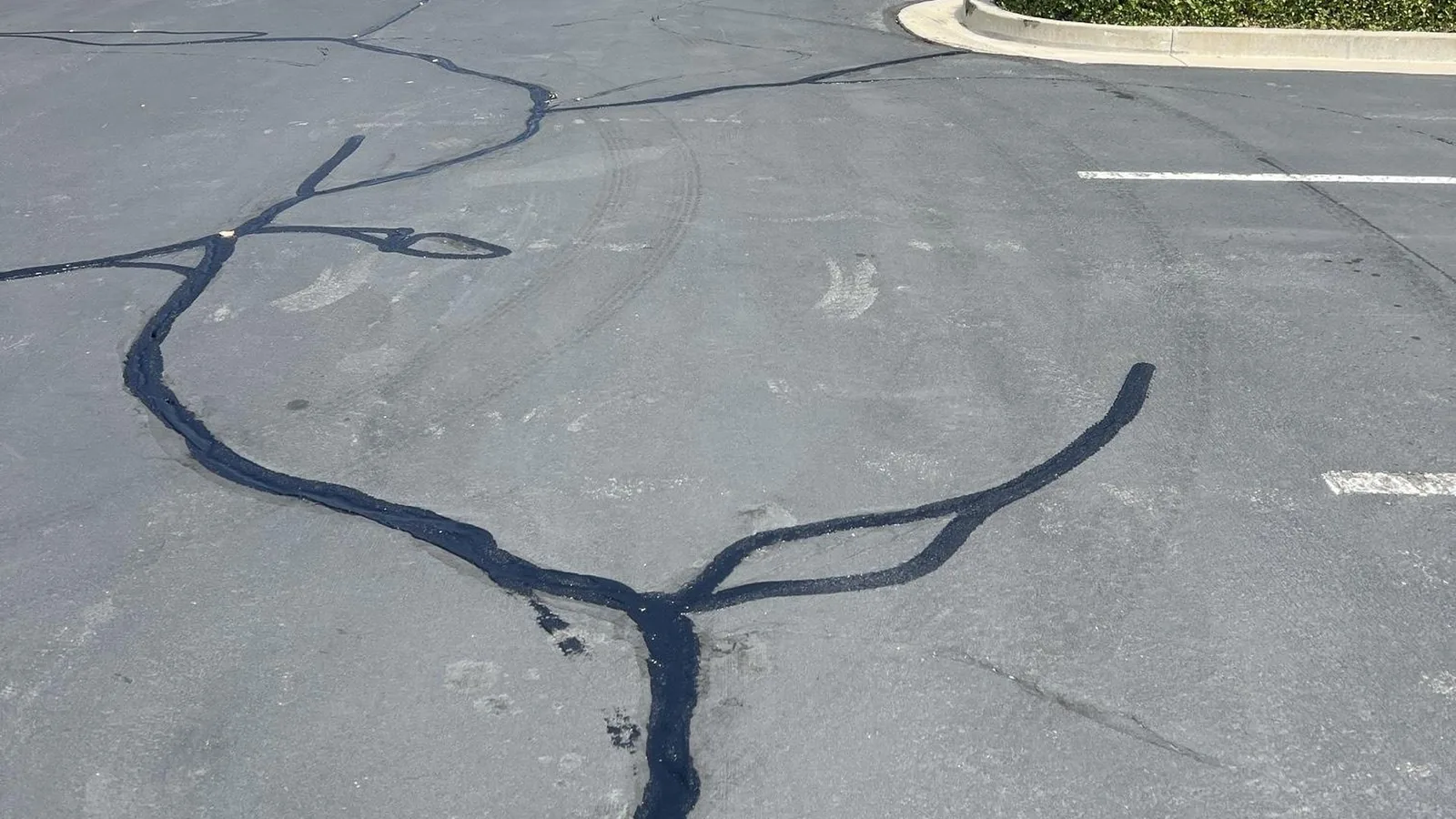
Crack sealing is for working cracks, the ones that open and close as Tennessee temperatures change. The crack is routed or sawn into a clean reservoir, then filled with a heated, rubberized sealant. A university-hosted pavement reference reports an average life of about 3 to 8 years. Crack filling is for larger, stable cracks that barely move. A national cost guide calls it a short-term fix of 1 to 2 years. In a federal field study, though, fillers placed in stable cracks held up 2 to 4 years, and fillers modified with rubber or fiber lasted 6 to 8.
For a driveway or parking lot in Tennessee, the rule of thumb is simple. Cracks that run across the pavement usually move, so they get sealed. Diagonal cracks and most lengthwise cracks often stay put, so they get filled. Greenfield Pavement Coatings routes and seals working cracks and fills stable ones as part of our crack sealing work.
What Is the Difference Between Crack Filling and Crack Sealing?
The federal highway agency’s crack sealing manual draws the line by movement. Crack sealing places specialized material above or into working cracks to keep out water and grit. Crack filling places ordinary material into non-working cracks. That cuts the water getting in and supports the pavement beside the crack. The agency’s pavement preservation checklist treats them as two treatments and starts by asking which one a project needs.
| Crack sealing | Crack filling | |
|---|---|---|
| What it is | Specialized sealant placed above or into the crack | Ordinary filler placed into the crack |
| Which cracks | Working cracks that open and close, usually across the pavement | Larger, stable cracks with little movement |
| How it is done | Reservoir routed or sawn, cleaned, then sealed hot | Cleaned and filled, usually with no reservoir cut |
| Materials | Rubberized asphalt sealant, heated in a melter | Asphalt emulsion, rubberized asphalt or a sand slurry |
| How long it lasts | About 3 to 8 years | 1 to 2 years in a cost guide; 2 to 8 years in a federal study, by material |
| Market cost | $0.50 to $3.00 per linear foot for crack repair | One published range covers both |
The cost row is market numbers from a national cost guide, not our price list. The life spans come from the pavement reference, the same cost guide and a federal crack treatment study.
How Do You Tell a Working Crack From a Stable One?
The federal manual says a crack’s yearly movement should be the main test, more than its width. In its glossary, a working crack moves about 3 millimeters or more, roughly an eighth of an inch. A non-working crack moves less than that. The manual adds that the type of crack usually tells you which one you have.
Working cracks usually run across the pavement, side to side. Non-working cracks typically include diagonal cracks, most lengthwise cracks and some block cracks. Because those cracks sit close together, each one moves very little.
Width still counts. The federal checklist routes working cracks wider than 1/8 inch, generally spaced more than 20 feet apart. A national cost guide says active cracks of 1/8 to 3/4 inch need sealer with rubberized asphalt. The same guide says contractors fill larger, stable cracks with asphalt emulsion.
Why Do Middle Tennessee Winters Matter for Cracks?
NOAA’s 1991 to 2020 normals give Clarksville 78.4 nights a year at or below freezing. Temperature change is what moves a working crack, the manual’s glossary says. So the sealant has to stick to the crack walls and flex as the crack opens and closes. The manual prefers rubber-modified materials made to stretch at low temperatures.
Water is the other half of the problem. A national cost guide says potholes start with moisture getting into cracks. The pavement reference says sealing keeps moisture out of the layers below. It also slows raveling, the crumbling of the crack edges. Asphalt can give years of service after small cracks appear, if they are kept sealed.
When Is the Best Time to Seal or Fill Cracks?
The pavement reference says crack sealing is best done in moderate temperatures, in spring or fall. It works best right after cracks develop. The federal checklist sets a floor of air and surface temperatures typically 40 F minimum and rising. Sealing does not go ahead if rain is imminent, or with moisture on the surface or in the crack.
On the day, the crack is cleaned out with blown air. Hot air blasting runs just ahead of a hot sealant to keep condensation off and the crack warm. Traffic stays off until the sealant has cooled or cured enough not to pick up on tires.
What Cracks Can Neither One Fix?
Alligator cracks, the web of small connected cracks, are past sealing. The pavement reference says this fatigue cracking usually needs a patch or reconstruction. Once the connected pattern forms, sealing is no longer effective. That is asphalt repair work.
Wide cracks everywhere tell a similar story. Where cracks are wider than about half an inch and numerous, the same reference points to a bigger fix. Removing and replacing the cracked layer, or overlaying it, is usually better. Our asphalt resurfacing page covers overlays. The repair, resurface or replace guide walks through that choice.
Should Cracks Be Sealed Before Sealcoating or an Overlay?
Yes, and the order matters. On a driveway or lot due for sealcoating, the cracks come first and the sealer goes on after. Our sealcoating cost guide covers the market numbers for that step.
Before an overlay, timing matters more. The federal checklist says to apply sealant at least one year before an overlay. That gap helps avoid bumps in the new asphalt.
Does a Parking Lot Need Crack Filling or Crack Sealing?
Several kinds of cracks can show up on a lot at one time. For that case, the federal manual favors one treatment. It calls for a material fit for the most demanding crack type. Where working cracks are in the mix, that points to a sealant.
Crack work on a lot is one part of parking lot maintenance, along with sealcoating and restriping.
What Does Crack Sealing Cost per Linear Foot?
A national cost guide puts asphalt crack repair at $0.50 to $3.00 per linear foot. Those are market numbers, not our price list. Every job is priced on its own cracks.
For a public benchmark, TDOT’s road contracts paid a statewide average of $1.57 a pound for crack sealant. That covers contracts from January to May 2026. It is a material price on highway work, not a driveway or lot price, and not ours.
Want Us to Look at Your Cracks?
Every driveway and lot cracks in its own way. We look at the cracks, sort the working ones from the stable ones and put the quote in writing. Our crack sealing service page shows how the work goes. Call or text (931) 362-7283.